How do I configure the module ?
Google Customer Reviews lets you offer buyers a survey about their shopping experience. The opt-in appears on the order confirmation page; Google may then email a survey to customers who agreed to participate. Responses can contribute to your store rating. This program is separate from Google Business Profile reviews.
A store rating requires enough unique, eligible reviews for a country within the last 12 months. Google says most merchants can obtain a rating after collecting 100 or more eligible reviews; this number does not guarantee that a rating will appear. See the rating display requirements.
Activate the program in Merchant Center
Make sure you have an active Google Merchant Center account and have verified and claimed the relevant website. You do not need to link the account to Google Ads to use Google Customer Reviews.
- In Merchant Center, open Settings → Add-ons.
- Under Discover, find Google Customer Reviews and activate it.
- Follow Google’s setup steps and accept the program agreement.
See the current activation procedure and the eligibility requirements. The module supplies the integration code on your shop; avoid adding a second survey opt-in integration through the theme or another module.
Check the shop prerequisites
In the module configuration, open Prerequisite check. Check the shop domain, SSL domain and SSL activation checks, then address any reported problems.
These checks alone do not validate the entire Google integration. The order confirmation page must use HTTPS and an HTML5 document. If payment takes place on another domain, customers must return to the confirmation page on your shop’s domain. Check that return for each payment method.
Enter the account ID and choose whether to display the badge
- Open Basic settings.
- Copy the relevant Merchant Center account ID into Your Google Shopping / Merchant Center ID. Google’s current help locates this ID at the top right of the account; do not confuse it with a Google Ads ID.
- For Display Customers reviews badge ?, choose YES or NO, then click Update settings.
The badge is optional. The survey opt-in can be integrated independently of its display. The reference to 100 eligible reviews concerns obtaining a rating; it does not guarantee its display. Without a rating, Google may display “Rating not available”.
The module uses the historical badge integration. Google is evolving it into a store widget, so its appearance may differ from older illustrations. Read the widget documentation before considering an additional integration.
Select order statuses
Open Order settings. Under Valid order statuses, select statuses that represent valid orders for your payment methods. “Payment accepted” is a common example; status names can vary between shops.
The current status must be selected when the customer reaches order confirmation, and PrestaShop must also consider the order valid. Selecting a status in the module does not itself validate an order. Save with Update settings.
Check every payment flow: buyers should be offered the opt-in on their order confirmation page. A later back-office status change does not, by itself, display a new opt-in to the customer.
Configure the estimated delivery date
Under Shipping settings, enter values that reflect your operations:
- If you dispatch orders on the same day, select Same-day order processing and set the Cut off time. At or after that time, the calculation starts from the following day.
- Otherwise, enter the Estimated order processing time, before transport. For example, Monday to Wednesday represents 2 days of preparation.
- Under Week-end / closed days, select days when you do not dispatch orders. Enter National holidays / additional closed days separately.
- Enter the Average transport time (in days) for each carrier, then save.
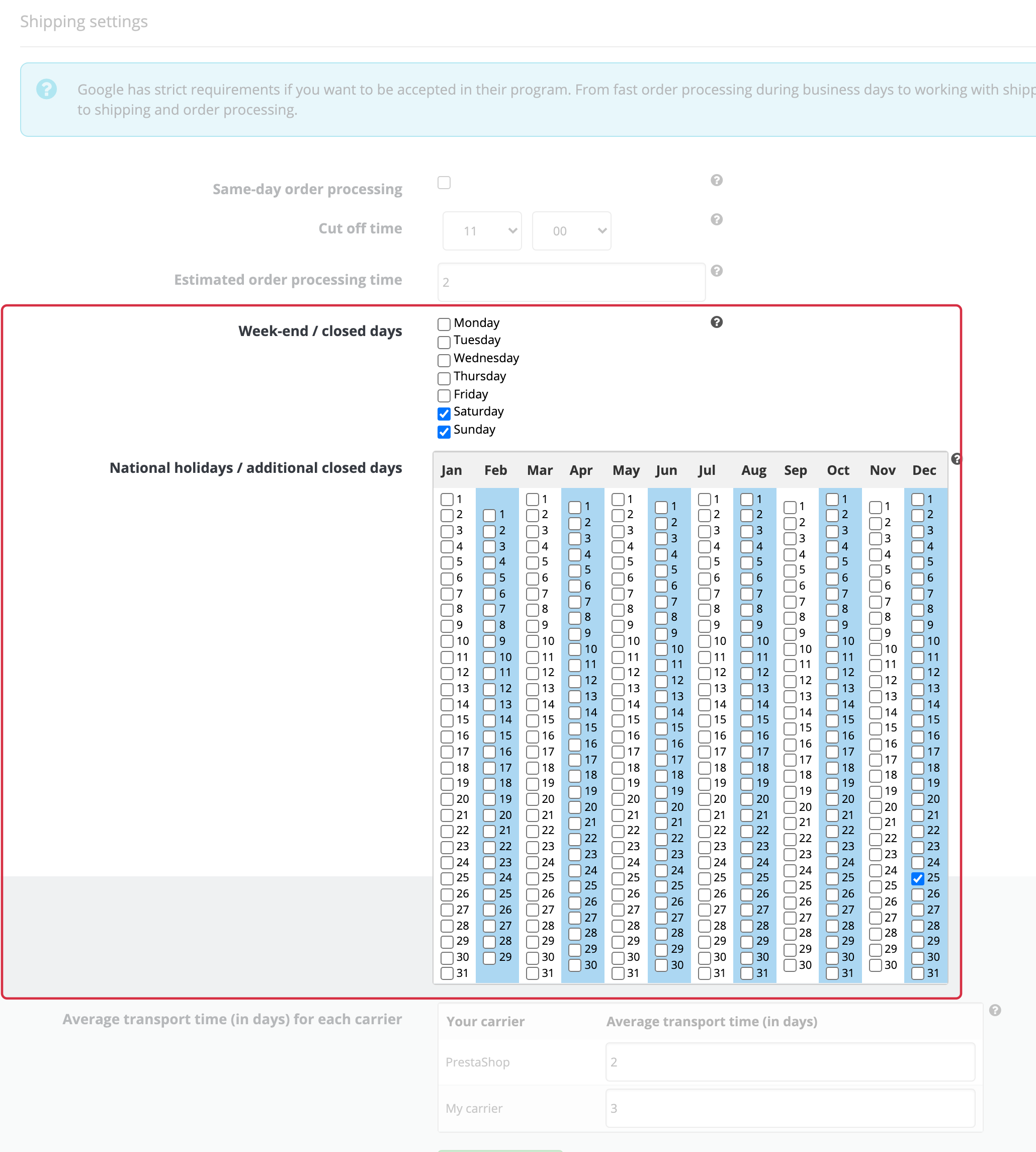
Weekly closures and annual dates are configured separately. In this fictional example, Saturday, Sunday and 25 December are selected; same-day processing is disabled and preparation is set to 2 days.
Preparation and transport are separate periods. The calculation adds calendar days; it should not be treated as a complete business-day calendar for preparation and transport.
Check the estimated date actually sent for representative orders, particularly around closed days, holidays, back-order items and after carrier changes. If it does not match the expected delivery time, have the calculation checked before relying on it.
The module supplies an estimated date; it does not schedule survey emails. Google decides whether to send a survey after that date to customers who opted in. Changing an order to “Delivered” does not trigger a survey email from the module.
Check the integration
Follow the test procedure to check the confirmation page and the opt-in. The integration supplies Google with transaction details including the order ID, customer email, delivery country and estimated delivery date. Agreeing to a survey and receiving an email are separate stages from displaying the window.
Then use the Google Customer Reviews dashboard to follow opt-ins, surveys offered and responses. Some customers who opt in may not receive a survey; dashboard metrics do not provide an instant check.