How to configure the Google Pay module?
Module - Google Pay
The module offers Google Pay at the end of checkout and, optionally, on the cart and product pages. The payment uses a card stored in the customer's Google account and is processed by Stripe.
To prepare your accounts, keys and Google Pay production access, first read the Google Pay installation FAQ.
1/ Basic configuration
Open Basic settings in the module configuration. Turn on Enable Test Mode to prepare your checks.
The form requests all four API keys, including when test mode is enabled:
- Stripe Test Publishable Key and Stripe Test Secret Key;
- Stripe Live Publishable Key and Stripe Live Secret Key.
Match each key to its environment. When test mode is enabled, the module selects the test pair; when it is disabled, it selects the live pair.
Enter your Google Pay Merchant ID, obtained through the Google Pay & Wallet Console as explained in the installation FAQ, then save.
This identifier is required for live payments. It is not sent to Google in test mode.
All four Stripe keys and the Google Pay Merchant ID are required to save the form, including in test mode.
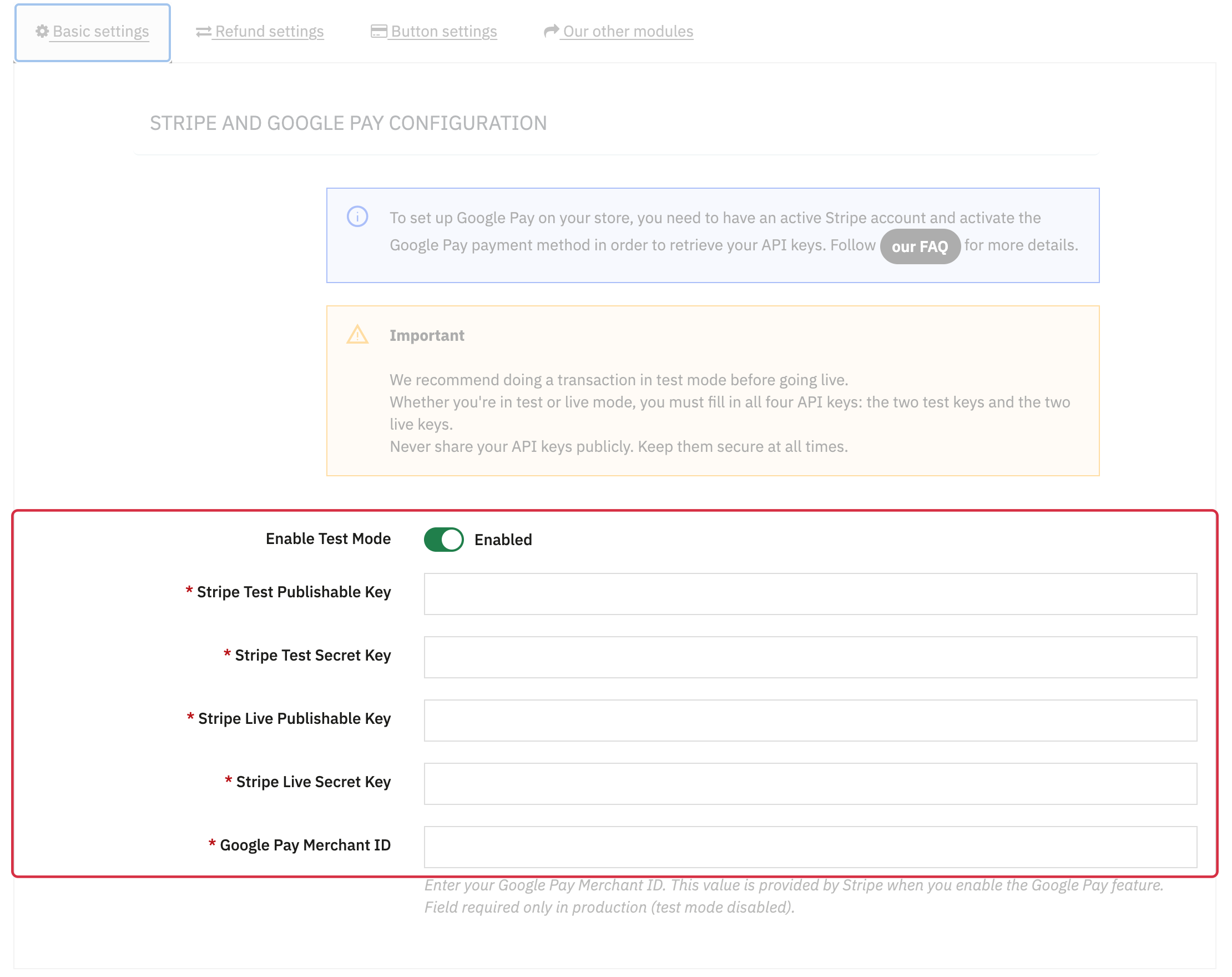
Test mode, the two Stripe key pairs and the Google Pay Merchant ID. The fields are deliberately empty in this example.
Complete your checks in test mode before enabling live payments.
Important: always store your secret API keys securely and never share them.
2/ Automatic refund configuration
In Refund settings, select only the order statuses you want to use to trigger a refund request, then save.
Important: to process a refund, you MUST first generate a credit slip in PrestaShop, then change the order status to one of the selected statuses. Without a credit slip, the module sends no automatic refund request.
After this change, open the relevant payment in your Stripe Dashboard and check the refund amount and status. Sending a request does not guarantee the customer has already received the funds.
Before using this mechanism on live orders, check the amount submitted in test mode for your refund cases, including partial refunds and shipping costs. Keep the same test or live mode as the original payment when checking the refund.
The PrestaShop credit slip is an order document; it does not prove that a Stripe refund succeeded. A refund issued manually in Stripe is a separate operation: check refunds already recorded against the payment before triggering the module mechanism, to avoid an additional request.
3/ Button customization and express checkout
Button appearance
In Button settings, choose the Google Pay Button Theme: Light Theme for a dark background, or Dark Theme for a light background. Save and check readability with your store theme.
Enable the cart and product page options
Enable Enable payment via Google Pay from the cart page? and/or Enable payment via Google Pay from the product page? for the locations you want, then save.
Important: only customers logged in to their customer account on your store can see and use express checkout on these pages. Signing in to Google does not replace signing in to the store.
If a logged-in customer has no saved address, enable Allow customer to create a new address? so they can enter one using the form provided by the module.
Important: if this option is disabled and the customer has no address, the express checkout block is not displayed. They can use the regular checkout to enter their information; the module does not automatically redirect them at this stage.
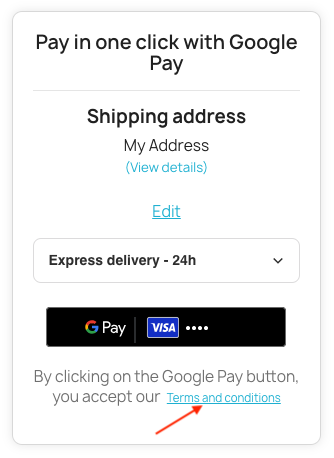
On the product page, the customer expands the express checkout block. They check their address and select an available carrier before paying. The payment button also depends on Google Pay being available in their environment.
Tip: express checkout can reduce the checkout steps for logged-in customers. Check this flow with your products, combinations, quantities and shipping methods.
Terms and conditions page
In Button settings, select the Terms and conditions page from your CMS pages, then save. The module provides a link to this page below the express payment button on the cart and product pages. Check its destination in each language.
4/ Checks before going live
- Check that test mode is enabled and the test keys match the Stripe environment you are viewing.
- On an HTTPS store, make a payment using the Google Pay test card suite for the Stripe gateway. Google Pay test mode data cannot be used for a live charge.
- Check the PrestaShop order confirmation and the payment in Stripe's test data. Also check the address, carrier, amount and any cart/product page flows you have enabled.
- Test a refund with a credit slip created before the status change, then compare the requested amount and result in Stripe.
- Once these checks pass and Google has approved your site for production, check the live keys and Google Pay Merchant ID. Then disable test mode in Basic settings and save to enable live payments.
Important: disabling test mode selects the live keys. Enabling test mode alone does not validate Google's permissions for the site or your complete store integration.